
Sindh Icons
Muhammad Khan Abro – A man who never gives up

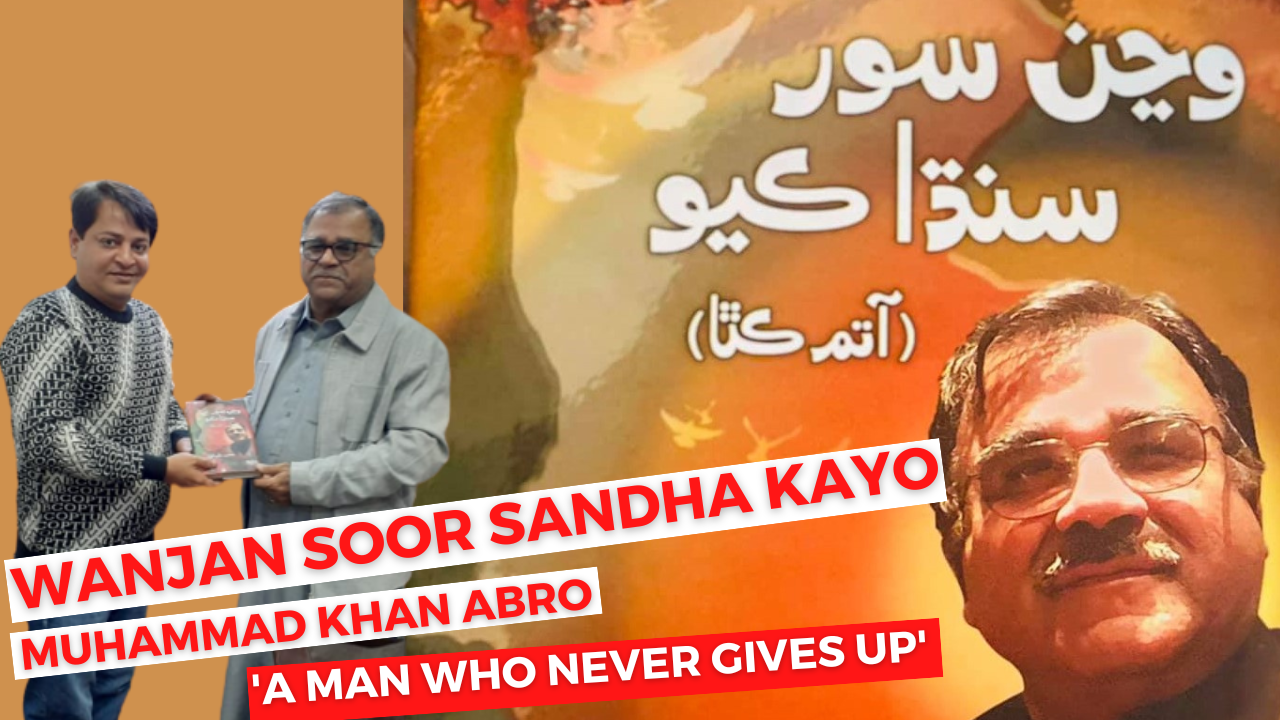
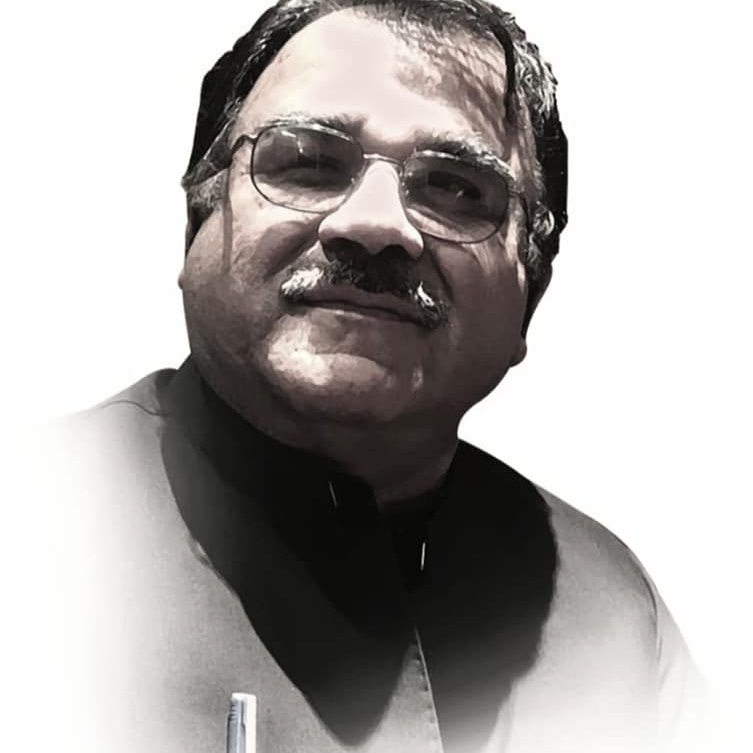
KARACHI: Nowadays, writing a book is a difficult job to do and writing untold truth about the life incidents including poverty, sadness, family background, overall crisis about personal life is a daunting task which needs proper concentration, courage and the best memory.
Muhammad Khan Abro is the man who has broken all the barriers while writing about his past unforgettable experiences proudly as people these days do not tell truth about their past life even to their young generation.
Muhammad Khan Abro’s life faced various worst-ever ups and down in his life since childhood however he never gave up and kept fighting with the norms of the society and achieved success in his life.
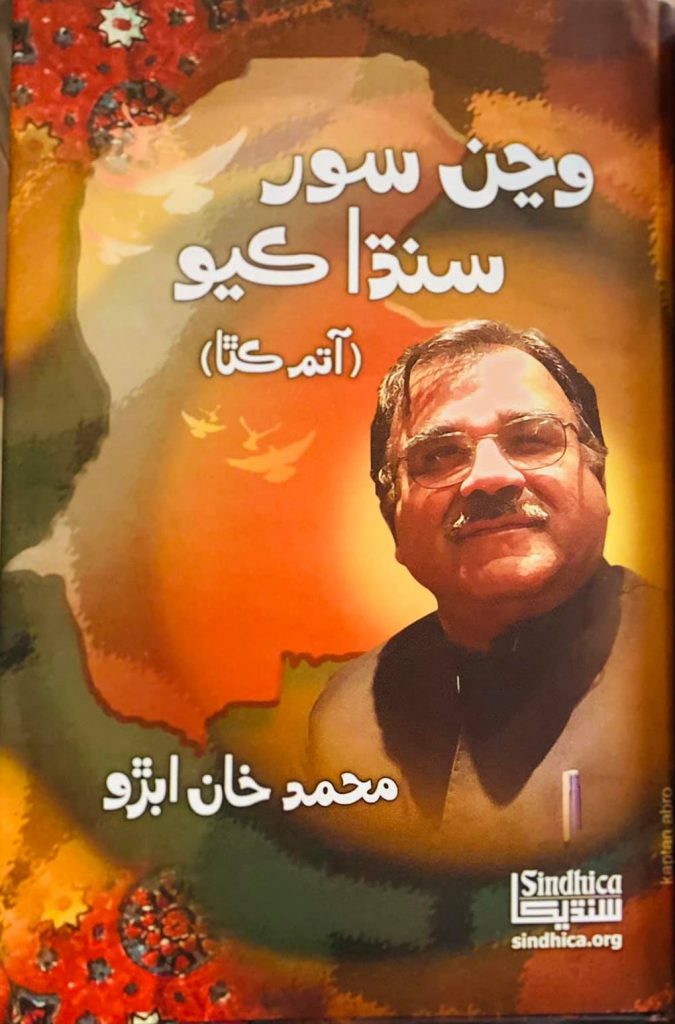
The courageous Muhammad Khan Abro has written each single happening whether it was good or bad in his largely appreciated book titled Wanjan Soor Sandha Kayo [ Let Break the Spell of Pain ] which is published by the Sindhica Academy, Karachi.
As far as his sharp memory is concerned, I met his for the first time in his office however he left me surprised when he identified my father who was close-friend when both were young and struggling in the metropolis for the people. He immediately referred me as ‘Bhateejaa’ (son of a brother). There is no doubt Muhammad Khan Abro has a sharp memory which a writer must have to write-down what he had faced and what he had gone through.
The book contain stories of his past life as usually people write for one’s life after he leave the world but this book can be termed as ‘written part of life’ that gives a glimpses of life of a poor boy who opened his eyes in a poor family when his village Bulhan, a small village of Boobak town near Sehwan Sharif, the resting place of world famous Sufi saint Hazrat Lal Shahbaz Qalandar. It is dedicated to those persons, who lit the light in the gloomy life of the author. These persons are authors’ mother, father and teacher.
Muhammad Khan Abro has passionately told his story that how his family migrated from tiny village Buhlan to Sehwan following Black Floods back in 1956. His village was under floodwater and gushing water was running below his cot inside his house.
The author has recalled old days of town, when it was brimmed up with life. Its routine social course was mingled with sublime interactions. In those days, co-existence was cultural code of town. Later on, the partition changed the town’s complexion. Hence, Sehwan like other towns of Sindh became a ghost town, and its streets gave the desert look. However, life retained its pace, and people migrated from nearby villages and occupied the vacated houses. But, those houses took time to become homes for new occupants. In that interval, spiritual hollowness captured the town.
Amidst period of isolation and monotony, the author finds a purpose of life, when he joins Jeay Sindh Students Federation. Prior to it, he has attended, Jeay Sindh Students’ grand gathering at Sindh University, Jamshoro. In fact, the author’s presence in that gathering was merely as an attendee, but environment changed him – he became a new person, he cherished a new dream and borne cost for its realization. He did worst type of manual jobs – sold ice cans, and transported fish form Sehwan to various cities of Sindh – Hyderabad, Larkana, and even Balochistan.
Finally, he passed matriculation and intermediate examinations. Another topic which author has sporadically mentioned is his deep involvement with the cause of Sindh. In addition to that, he has openly shown his love for GM Syed.
The author’s memoirs about Jeay Sindh Students Federation’s activism tells us a lot about those times that how nationalist politics elevated profiles of common persons. The case in point is author’s success in students’ elections of Government Boys College, Sehwan. The success in elections quickly and permanently changed his status in Sehwan, one of the power-centered towns of Sindh.
The author’s selectively narrated pieces tell that how power operates at local level. He has also openly pointed out that in 1970s, Pakistan Peoples’ Party forcefully used government officials for winning students’ elections in colleges. The author has quoted two examples – one example is of an education officer, who was pressurized by the then Minster Mr. Abdul Waheed Katpar. The Minister threatened the official to stop his boy from joining the panel of Jeay Sindh Students Federation. In another situation, one candidate named Qurban was forced through local landlord to withdraw his candidature.
Apart from it, the author has also narrated numerous events of internal politics of Jeay Sindh Students Federation that how the central leadership used to manage units or districts’ elections. In the whole narration Jeay Sindh Students Federation, Sindh University and GM Syed are most frequent themes.
Muhammad Khan Abro’s book invites us to reflect that how society operates at local level, and how interest groups support and contradict each other.
What I learnt by reading this book is that no one can stop you from achieving goals of your life if you have a will to do it. Muhammad Khan Abro used to help his mother in collecting Cow Dung early in the morning to ensure lighting of fire for food etc, cleaning his house and then go for studies and labor job.
The other inspiring thing that attracted me is there is no age limit to study and if you are willing just break the barrier and get education whenever you want. In my opinion the book is a ‘must read’ to read about the life experiences of Muhammad Khan Abro, structure of the society, good and bad things of the past etc.





Sindh Icons
Syed Hasan Askari – An evolution expert, a civil engineer, a lawyer, sportsman, humbled person

KARACHI: Opening his eyes in the well-educated and well-off family, Syed Hasan Askari son of SM Askari was born in Karachi’s Gulshan-e-Iqbal area on January 15, 1966. His father SM Askari was a senior government officer who had served the Civil Aviation Authority (formerly Airport Development Authority) as Director Finance.
Mr Hasan Askari has four brothers and a sister and all of them are highly qualified and outshined in their careers.
Hasan Askari received his primary and secondary education from Karachi’s prominent educational institution – Habib Public School -. He passed his matriculation from the Board of Secondary Education (BSEK) in 1981. He clinched A-grade.

He passed his intermediate from the well-reputed and historic institution – D J Sindh Government College -, affiliated with the Board of Intermediate Education Karachi (BIEK) in 1983. Yet again, he grabbed A-grade.
Apart from academics, Hasan Askari was an extraordinary student too who always took active part in extracurricular activities like playing sports, debate competition etc.
Mr Askari had qualified for the admission in the Pakistan’s well-reputed and prominent engineering varsity – NED University of Engineering and Technology – from where he passed Bachelors of Engineering (B.E) in Civil in 1989. Like his earlier academic achievements, he again outshined and grabbed First Division.

With an engineering degree in hand, Syed Hasan Askari had joined the ECIL Consulting Services, an engineering firm, who was tasked to construct Karachi – Hyderabad Dual Carriageway in 1992. He had also briefly served at the Naval Dockyard as an Engineer.
In 1992, Hasan Askari joined the Schon Group as Civil Engineer where he had served with utmost dedication and honesty. In the meantime, he also appeared in the most competitive and toughest examination held by the Sindh Public Service Commission (SPSC) that he had qualified with flying colours.
In 1993, Syed Hasan Askari joined the Education and Literacy Department, Government of Sindh as Assistant Executive Engineer (AEN) BS-17. He had served as AEN in Karachi’s West and South districts for a longer period of time.

Particularly in district South, he is the man who had introduced rehabilitation and restoration of historic educational buildings including NJV, DJ Science College and many others.
On the sidelines of the shining job career, Mr Hasan Askari also completed his LLB from the SM Law College. He also passed his Masters of Business Administration (MBA).
In 2013-14, Mr Hasan was promoted to the post of Executive Engineer (XEN) BS-18. He devotedly served in Korangi, East districts and Bin Qasim areas where the condition of the government schools are far better than the rest if compared.

In 2021, he was promoted to the post of Superintending Engineer (SE) BS-19. He briefly served in Mirpurkhas district and later he was posted in Karachi where he had served in Karachi’s Central, South, West and Keamari districts. He was awarded as the Best Superintending Engineer of Sindh.

With his outstanding performance aimed at improving infrastructure of the government schools, Hasan Askari was promoted to the post of Chief Engineer (BS-20) in July 2024. Presently, Syed Hasan Askari is working as Chief Engineer, Education Works Karachi, Education and Literacy Department, Government of Sindh.
Sindh Icons
Rafia Javed’s journey from a village girl to an educationist, promoter for girls’ education

KARACHI: With cuteness on face, bold and attractive personality, Rafia Javed daughter of Nazar Hussain was born on july 15, 1975 at Sita Nandhi a village near district Dadu. Her family had a prominent background in the area and her father was a government employee who worked at the local court.
Rafia Javed has two sisters and two brothers and all of them are highly educated and well-settled.
With limited resources, Rafia received her early education from the Seeta Nandhi Primary School while she received primary education from the Seeta Road High School. She passed her matriculation from the Board of Secondary Education Hyderabad in 1990. She clinched A-grade.
Rafia had to walk three to four kilometer daily to attend school which is the point that led her to be strong and study hard to be an extraordinary student.

Rafia did her intermediate from the Government Girls College, Dadu, affiliated with the Board of Intermediate Education Hyderabad in 1992. Yet again she grabbed A-grade in intermediate examinations. She also started teaching at her school to promote girls’ education.
Since childhood, Rafia remained a girl with helping nature who always had helped his colleagues, helped them in their studies. She also took active part in literary activities and debate competitions in school and college.
With an aim to do something extraordinary in life and achieve success where she can contribute to the society, Rafia Javed got admission in the Sindh’s premier education institution – University of Sindh – from where she completed Bachelors of Arts (BA) in English Literature. She also did her Masters of Arts (MA) in English Literature. Again, she outshined in the university.

On the sidelines of her studies, Rafia used to arrange workshops and seminars for the university. She also wrote articles for regional newspapers on different topics particularly girls’ education. Apart from her university education, she had also worked as Sub-Editor with Ibrat Magazine.
In 2001, Rafia Javed had passed the examination held by the Sindh Public Service Commission (SPSC) and she choose to join the Education and Literacy Department, Government of Sindh.
Firstly, Rafia had served as Lecturer BS-17 who taught English at various colleges. Then she was posted as Assistant Director in the Education and Literacy Department where she had served with utmost honesty and dedication.

Rafia had also served as Deputy Secretary in the Universities and Boards Department, Government of Sindh for couple of years.
She had also served as Controller of the Board of Secondary Education Karachi (BSEK) where she outperformed and brought major administrative and curriculum changes to ensure best quality of education for the students of the metropolis.
With her devotion and expertise in education sector, Rafia Javed was posted as Registrar, Directorate of Inspection & Registration of Private Institutions Sindh for couple of years. After her promotion to the next higher grade, Rafia has been working as Additional Director at the Directorate of Inspection & Registration of Private Institutions Sindh till date.
Rafia Javed is a notable figure in the field of education in Sindh, Pakistan. She is recognized for her contribution to education reform, advocacy for girls’ education, and her efforts to improve the quality of education in rural and underprivileged areas of Sindh.
She has been a strong advocate for girls’ education, particularly in rural Sindh where cultural and socioeconomic barriers often limit access to schooling for girls. She has worked on initiative to improve teacher training and professional development, ensuring that educators are better equipped to deliver quality education.

Rafia has emphasized the importance of community involvement in education, working to engage parents and local leaders in supporting schools and educational programs due to it she has established two libraries one at Sita Road and another at Khan Pur. Her work has also extended to influencing education policies at the provincial level, aiming to create systemic changes that benefit students across Sindh.
Rafia’s efforts are part of a broader movement to address these issues and create a more equitable and effective education system in the region.

KARACHI: Opening his eyes in the well-educated and well-settled family, Arshad Hussain Bhutto son of Muhammad Hussain Bhutto (late) was born on February 29, 1968 at Hyderabad, the second largest city of Sindh province. His father was a Professor by profession who was associated with the Education and Literacy Department, Government of Sindh.
Arshad Hussain Bhutto has two brothers and two sisters and all of them are well-educated and well-settled.
Mr Arshad received his primary education from the Model School, Old Campus in 1973. He passed his matriculation from the Board of Secondary Education Hyderabad in year 1983. He clinched A-grade in the matriculation.

He completed his intermediate from the Board of Intermediate Education Hyderabad in 1985. Yet again he passed his intermediate with flying colours.
Arshad Bhutto was an outstanding students in his studies who always took active part in debate and writing competitions. He also won several medals for his extraordinary skills.
Besides, Arshad also played cricket and football in his school and college level and represented cricket and football teams at different districts.
While finishing his intermediate, Arshad Hussain qualified the selection process and got admission in the premier engineering university of the Sindh province – Mehran University of Engineering and Technology (MUET) Jamshoro – from where he passed his B.E (Civil) in 1991. He grabbed First Class in the university.
Mr Arshad always wanted to prove himself as the meritorious student and true and hardworking son of honest father who tasked him just to focus on studies and made them feel proud in the field of education.

With distinctive engineering degree, Arshad Bhutto appeared in the most competitive examination held by the Sindh Public Service Commission (SPSC) in 1992 in which he had qualified for the post of Assistant Executive Engineer (AEN) BS-17, Works and Services Department, Government of Sindh.
While serving the people of the province by ensuring best quality services, Mr Bhutto had served as AEN in different districts till 2012. He was then promoted to the post of Executive Engineer (XEN) BS-18 and served in various districts of the province until 2018. Arshad Bhutto was then promoted to the post of Superintendent Engineer (SE) BS-19 in 2018.
In 2023, Arshad Bhutto was promoted to the post of Chief Engineer (BS-20) and posted as Chief Engineer, Buildings Division Karachi. Mr Arshad has worked with utmost dedication, honesty and sincerity in various districts including Tando Muhammad Khan, Badin, Hala, Jacobabad, Matiyari, Karachi etc.


Major Dacoity

Saudi opens liquor store in Riyadh

SAMBARA INN

Sharjeel Inam Memon calls on President Asif Ali Zardari

Syed Hasan Askari – An evolution expert, a civil engineer, a lawyer, sportsman, humbled person

Rafia Javed’s journey from a village girl to an educationist, promoter for girls’ education
Sharjeel Inam Memon calls on President Asif Ali Zardari
Syed Hasan Askari – An evolution expert, a civil engineer, a lawyer, sportsman, humbled person