
Sindh
Ajrak – The 5,000 years-old tradition of Sindh

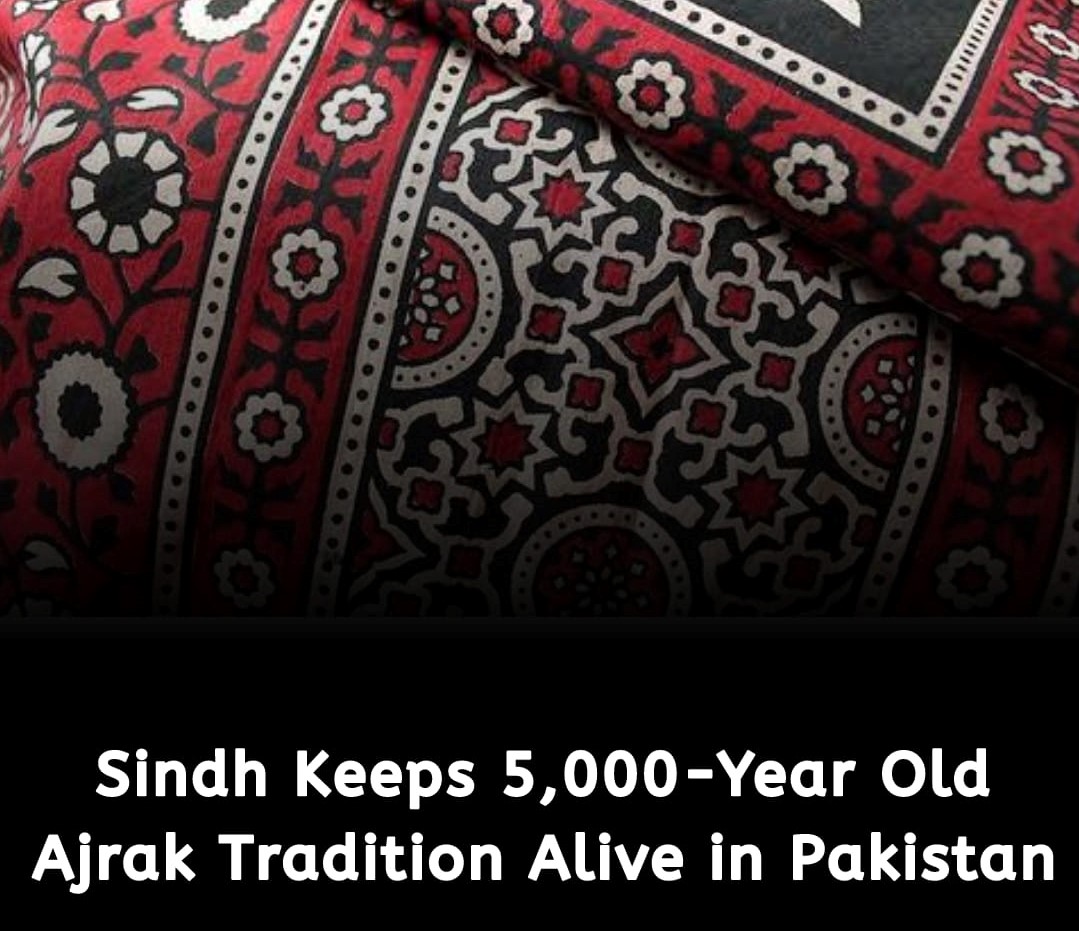
KARACHI: Ajrak is a unique and traditional form of block-printed shawl or scarf that is indigenous to the Sindh region of Pakistan and parts of India.
The art of Ajrak has been practiced for over 5,000 years and is deeply ingrained in the cultural heritage of the Sindhi people. The intricate designs and patterns of Ajrak reflect the natural elements of the region, such as the sun, moon, and stars.
Ajrak and caps are also the influence of Arabs. Ajrak, which is demanded in the whole world, is prepared in many stages. From its coloring to designing, every step is done by hands. The base color of Ajrak may change with the areas. In some areas black and in some areas red or blue colors are used as base.
The Ajrak consists of four colors, white, red, Black and Blue. For designing, about 144 stamps are used. Ajrak can be called the identity of Sindh and Sindhi people. Ajrak is a symbol of pride and respect for men and glory for women. Sindhi people also present Ajrak as a gesture of hospitality to their guests.
Ajrak is literally used in Sindh (Pakistan) from the cradle to the grave. In Sindh, Ajrak holds significant importance. Here, after someone passes away, they are wrapped in Sindhi Ajrak along with their shroud.It is used as a hammock for infants, headgear for girls, bridal accessory, a turban and a shawl, a bed cover, a tablecloth, a gift item and a token of respect to honor a guest.
Most of the heads of state and dignitaries of Pakistan have used ajrak in their public meetings to show respect and as a token of solidarity for Sindh Province. It is amazing to see that Sindhi Ajrak is flourishing internationally.
The symbol of respect and culture of Sindh, Pakistan, has come so far and known for its simplicity and hard work behind it. Moreover, it is said that the Ajrak artisans in India are originally from Sindh, Pakistan. The craft is also very popular across states of India, inlcuding Rajasthan and Gujarat.





ISLAMABAD: Sindh Senior Minister Sharjeel Inam Memon called on President Asif Ali Zardari at the President’s House Islamabad. Senior Minister Sharjeel Inam Memon gave a detailed briefing to President Asif Ali Zardari on several development projects in Sindh, specifically ongoing transport projects.
President Asif Ali Zardari ordered that all transport projects in Sindh be undertaken through modern technology.
President Asif Ali Zardari instructed to increase the numbers of Pink Taxi and Pink Scooty to provide special facilities to women.
President Asif Ali Zardari also said that women empowerment is our top priority, and these projects not only offer vital facilities but are also an important landmark in generating new job opportunities for women.

KARACHI: In a remarkable move, the 7th Agricultural Census 2024 – Integrated Digital Count was officially launched here on Wednesday.
The event, held in Karachi, was marked by the participation of key dignitaries, including Mr. Muhammad Ali Malkani, Minister for Livestock and Fisheries, Government of Sindh, and Syed Nasir Hussain Shah, Minister for Planning and Development and Energy, Sindh and Dr. Naeem-uz-Zafar, Chief Statistician, Pakistan Bureau of Statistics (PBS), whereas secretaries, director generals and other officers of different provincial departments also attended the launch.

Dr. Naeem-uz-Zafar, in his keynote address, emphasized the transformational nature of this census. “This is not just a data collection exercise; it is a foundation for evidence-based decision-making that will steer our agriculture sector towards sustainable growth. For the first time, we are adopting an integrated and fully digital approach, combining agricultural, livestock, and machinery censuses into a single, comprehensive operation,” he stated.
Highlighting the census’s objectives, Dr. Naeem-uz-Zafar added, “The 7th Agricultural Census will provide critical insights into Pakistan’s agrarian structure, crop patterns, livestock population, and mechanization trends. The use of advanced tools such as tablet-based data collection, GIS dashboards, and real-time monitoring ensures accuracy, reliability, and timeliness. This initiative aligns with international best practices and Food and Agriculture Organization (FAO) guidelines.”

He detailed the preparations, including the extensive training of 1,695 enumerators and supervisors across 30 venues in Sindh, to ensure the quality of data collection. He also underscored Sindh’s vital role in Pakistan’s agricultural economy, with its 8.2 million acres of cultivated land and major contributions to crops like cotton, rice, sugarcane, and wheat.
Speaking on the occasion, Muhammad Ali Malkani, Minister for Livestock and Fisheries, echoed these sentiments in his address. “This census is a historic step towards modernizing our agricultural practices and addressing the challenges of food security, climate resilience, and rural development. Sindh’s agriculture sector is the backbone of its economy, supporting 37 percent of our population. The insights gained from this census will empower policymakers to make informed decisions and drive sustainable progress,” he remarked.
The Minister also lauded the collaborative efforts between federal and provincial governments, academia, and relevant stakeholders in making this initiative a reality. “The data we collect will have far-reaching impacts, shaping policies that uplift farmers, enhance productivity, and strengthen food security,” he said.

The event also featured Syed Nasir Hussain Shah, Minister for Planning and Development and Energy, who reiterated Sindh’s commitment to supporting innovative initiatives like the Integrated Digital Count. “Our government firmly believes in using technology to address the challenges faced by our agriculture sector. This census is a critical step in achieving that vision,” he stated.
The journalists present on the occasion asked questions from the dignitaries regarding the reasons of 16 years gap since the last agricultural census, and the validation, relevancy and efficacy of this census in the face of continual climate crisis. The field operations for the census will run from January 1 to February 10, 2025, with the final results expected by August 2025. This initiative reflects dedication and cooperation between the federal and provincial governments to leveraging technology for governance and ensuring the sustainable development of the agriculture sector.


KARACHI: With an aim to lower the financial burden on the provincial exchequer, the Sindh Solid Waste Management Board (SSWMB) started to pay private companies contracted for garbage disposal in the city in local currency instead of US dollars.
In this regard, Managing Director SSWMB Syed Imtiaz Ali Shah held a meeting with representatives of the private firms responsible for disposal of garbage in the city and apprised them of the decisions made by the steering committee of the Board.
The meeting deliberated upon the new plan of garbage disposal in the city before the expiry of the contracts made with private firms for solid waste management on district West, Malir, Keamari and East.
It was informed in the meeting that the negotiation with the contracting firms for payment in local currency had already been started.
The representatives of the private firms working in district Malir, West and Keamari informed the meeting that the verification of the staff and vehicles had been completed through a third party, while the verification was still going on in district East.
The managing-director directed the officials concerned to take steps to further improve efficiency in the new operational plan.
He asked the officials to make union committee-wise operational plan, containing complete details of daily waste volume, transport, machinery, staff and all resources to further improve the door-to-door waste collection services.
He also directed the private companies to pay the salaries of their respective staff on time. Mr Shah said that the operational plan should also include training of the staff, the strategy of separate collection of waste and date of people who picked garbage illegally.


Major Dacoity

Saudi opens liquor store in Riyadh

SAMBARA INN

Sharjeel Inam Memon calls on President Asif Ali Zardari

Syed Hasan Askari – An evolution expert, a civil engineer, a lawyer, sportsman, humbled person

Rafia Javed’s journey from a village girl to an educationist, promoter for girls’ education
Sharjeel Inam Memon calls on President Asif Ali Zardari
Syed Hasan Askari – An evolution expert, a civil engineer, a lawyer, sportsman, humbled person