
Sindh
Murad asks for study of Martial Laws, MQM, JI’s Mayorship to ascertain Karachi’s destruction

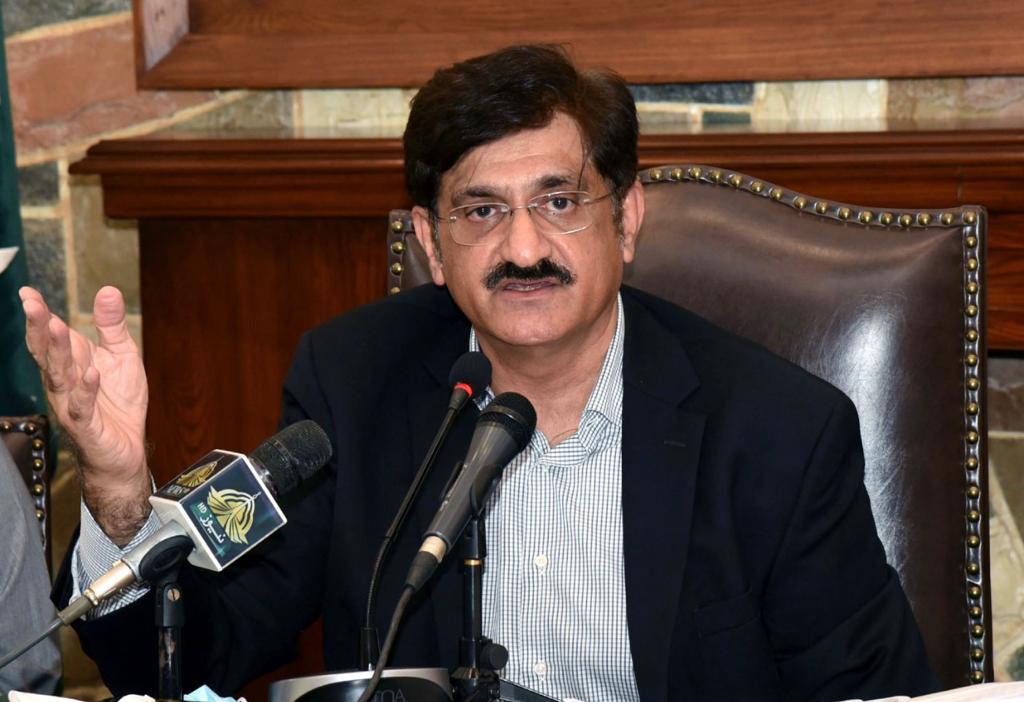
KARACHI: Sindh Chief Minister Syed Murad Ali Shah has said that the city received a record rain of 342.4 mm between July 10 (from 8 pm to July 11 upto 2 pm) even then the rainwater was disposed of as and when the rain stopped.
“But some so-called champions of the city are accusing the provincial government of its failure to drain out the accumulated rainwater, as a matter of fact the city was cleared, except the low lying areas by the evening of July 11.”
This he said while addressing a press conference at CM House. The provincial ministers, Sharjeel Inam Memon, Imtiaz Shaikh, Syed Nasir Shah, Advisor to CM Rasool Bux Chandio were present on the occasion.
Shah said that in 2007 the city had received 140 mm rainfall and the entire city had turned into the largest cesspit of stagnant water and over 200 people had died. The then minister of health had given these figures. “It was not our tenure and the city had drowned with a downpour of 140 mm,” he was surprised.
Talking about July 2009 rains, Murad Ali Shah said that the city had received 200 mm rainfall which had claimed over 52 lives. He added that the rainfall of 125 mm on August 31, 2009 in the city created one of the greatest havoc of urban flooding, and traffic jams had lasted for many days. “That time the world’s best nazim was ruling the city but even then, everything went upside down,” he recalled.
Shah, showing a slide of some newspapers on the screen of 150 mm rainfall in August 2020, said seven people had died and the city had turned into a gigantic cesspool. Contrary to 2007, 2009 and 2020, the city received 342.4 mm rain, including 106 mm in July and 126 mm upto 2pm on July 12. “This was a record rainfall in the history of the city but now the infrastructure of the city in terms of disposal of the water was built, therefore the rainwater disposed of within 24 hours and our teams comprising provincial ministers, advisors and government officers suctioned out water from the depressions, low-lying areas and from the underpasses with the help of machinery and pumps.
The CM said that people slaughter sacrificial animals on the roads. “The district central has the largest number of slaughters in the country,” he said and added the Solid waste management had started lifting the offal when the rain started, therefore the lifting [the offal] work was stopped, and the backlog emerged and now it has been cleared.
Murad Ali Shah said that after completion of Clifton Sewage pumping station for Rs493 million it catered to the sewage disposal of large areas and served the various vicinities, including Clifton Blocks: 1 to 9, Bath Island, Clifton, Civil Lines and Cantt: Station areas. I.I. Chundrigar Road. Shahrah-e-Faisal, Starting from Gora Graveyard, M.A. Jinnah Road, Bolton Market & Kapra Market, Saddar and Old City Areas, Lines Area, Lucky Star, Nishtar Road, Napier Road and Jodia Bazar.
The CM said that KWSB had a fleet of 36 Suction and Jetting Machines upto the year 2010. “Frequent sewage overflows are encountered across Karachi due to overloading of the sewerage system,” he said and added that the addition of 20 new Suction & Jetting Machines has improved KW&SB’s capacity to clean and de-silt the affected sewerage system of Karachi.
Shah said that another lot of 56 Suction & Jetting Machines were being added to existing fleet under the World Bank funded KWSSIP Project and in this way the total number of Machines would be increased to 112 within next six months.
To a question the chief minister said that the storm-water system was not designed for such a huge rainfall. “The cities London has such a huge storm water drain because it receives the rain, light and heavy, almost the whole year,” he said and added we, in Karachi receive such heavy downpour once in five to eight years, therefore we could not afford to invest billions of rupees on its expansion by digging the entire city.
According to the CM these heavy rains were the results of climate change, and his government was working on different projects to mitigate its effects. The CM said that various areas such as Saadi Town, areas of cantonments have been constructed on the natural waterways which have blocked the natural flow of rainwater in gravity. He added that the local government office at Tughlaq House was built on the storm water drain, similarly, parking of Ombudsman, Supreme Court, Shaheen Complex and a media house was built on the storm water drain.
“I have not built or allowed these encroachments on the nullah but yes, I’ll talk to the cabinet and if they allow me I would bulldoze the Local government department office on the nullah and then request the others to follow the course,” he said.
Murad Ali Shah questioned who had commercialized the main roads and allotted the lands on and along the storm water drains. “I would urge the media to explore the tenures of Martial Laws, Jamaat Islami, MQM and PTI in terms of allowing illegal construction, illegal allotment and commercialization and allowing establishment of residential societies on the natural waterways and who had played havoc with this city and its resources,” he suggested the TOR of stories.
Replying to a question, Mr Shah said that the DHA has a problem in disposal of rainwater. “Last year they [DHA] had constructed a drainage system but it failed to cater to the requirement of such a heavy rain,” he said and added his government was in touch with DHA and cantonment authorities to help them.
The CM said that when he had visited different nullas and pumping stations he discovered that the plastic shopping bags had choked them. “We would have to address this issue seriously,” he said.
To a question about MQM criticism of the Sindh government, Murad Ali Shah said that they were in opposition. “They are not our partners in the provincial government and the local bodies elections are over the head- the criticism might be aimed at attracting the voters,” he said.
The CM said that his leadership would scold them if any of the provincial ministers or leaders chose to criticize the MQM as they were. He urged the MQM leadership to take note of their leaders’ press conferences and statements.
The chief minister said that his government has served people of the city with heart and soul. “I sure the PPP would clinch the slot of Mayer during the upcoming local bodies election,” he hoped.
Criticizing the PTI, the CM said that they had 14 seats from the city and ruled around four years in the Center, but they did not give anything to this city, except the lip service. “PTI was given 14 seats and how they had got them I know very well,” he said and added “one of my friends in PTI confided in me that he was sleeping at his home and when he woke up in the morning, he was told that he had returned in the election.”
To another question, the CM said that one of the PTI MPA was saying that 22 cases have been registered against you. “These cases would not be framed if he stops land grabbing,” he said and added he has nothing to do with framing the cases, but the law was taking its own course. Mr Shah said that Nooriabad Power Plant was supplying 100 MW uninterrupted electricity to Karachi but even then, a reference was filed against him which he and his team were facing.





ISLAMABAD: Sindh Senior Minister Sharjeel Inam Memon called on President Asif Ali Zardari at the President’s House Islamabad. Senior Minister Sharjeel Inam Memon gave a detailed briefing to President Asif Ali Zardari on several development projects in Sindh, specifically ongoing transport projects.
President Asif Ali Zardari ordered that all transport projects in Sindh be undertaken through modern technology.
President Asif Ali Zardari instructed to increase the numbers of Pink Taxi and Pink Scooty to provide special facilities to women.
President Asif Ali Zardari also said that women empowerment is our top priority, and these projects not only offer vital facilities but are also an important landmark in generating new job opportunities for women.

KARACHI: In a remarkable move, the 7th Agricultural Census 2024 – Integrated Digital Count was officially launched here on Wednesday.
The event, held in Karachi, was marked by the participation of key dignitaries, including Mr. Muhammad Ali Malkani, Minister for Livestock and Fisheries, Government of Sindh, and Syed Nasir Hussain Shah, Minister for Planning and Development and Energy, Sindh and Dr. Naeem-uz-Zafar, Chief Statistician, Pakistan Bureau of Statistics (PBS), whereas secretaries, director generals and other officers of different provincial departments also attended the launch.

Dr. Naeem-uz-Zafar, in his keynote address, emphasized the transformational nature of this census. “This is not just a data collection exercise; it is a foundation for evidence-based decision-making that will steer our agriculture sector towards sustainable growth. For the first time, we are adopting an integrated and fully digital approach, combining agricultural, livestock, and machinery censuses into a single, comprehensive operation,” he stated.
Highlighting the census’s objectives, Dr. Naeem-uz-Zafar added, “The 7th Agricultural Census will provide critical insights into Pakistan’s agrarian structure, crop patterns, livestock population, and mechanization trends. The use of advanced tools such as tablet-based data collection, GIS dashboards, and real-time monitoring ensures accuracy, reliability, and timeliness. This initiative aligns with international best practices and Food and Agriculture Organization (FAO) guidelines.”

He detailed the preparations, including the extensive training of 1,695 enumerators and supervisors across 30 venues in Sindh, to ensure the quality of data collection. He also underscored Sindh’s vital role in Pakistan’s agricultural economy, with its 8.2 million acres of cultivated land and major contributions to crops like cotton, rice, sugarcane, and wheat.
Speaking on the occasion, Muhammad Ali Malkani, Minister for Livestock and Fisheries, echoed these sentiments in his address. “This census is a historic step towards modernizing our agricultural practices and addressing the challenges of food security, climate resilience, and rural development. Sindh’s agriculture sector is the backbone of its economy, supporting 37 percent of our population. The insights gained from this census will empower policymakers to make informed decisions and drive sustainable progress,” he remarked.
The Minister also lauded the collaborative efforts between federal and provincial governments, academia, and relevant stakeholders in making this initiative a reality. “The data we collect will have far-reaching impacts, shaping policies that uplift farmers, enhance productivity, and strengthen food security,” he said.

The event also featured Syed Nasir Hussain Shah, Minister for Planning and Development and Energy, who reiterated Sindh’s commitment to supporting innovative initiatives like the Integrated Digital Count. “Our government firmly believes in using technology to address the challenges faced by our agriculture sector. This census is a critical step in achieving that vision,” he stated.
The journalists present on the occasion asked questions from the dignitaries regarding the reasons of 16 years gap since the last agricultural census, and the validation, relevancy and efficacy of this census in the face of continual climate crisis. The field operations for the census will run from January 1 to February 10, 2025, with the final results expected by August 2025. This initiative reflects dedication and cooperation between the federal and provincial governments to leveraging technology for governance and ensuring the sustainable development of the agriculture sector.

KARACHI: With an aim to lower the financial burden on the provincial exchequer, the Sindh Solid Waste Management Board (SSWMB) started to pay private companies contracted for garbage disposal in the city in local currency instead of US dollars.
In this regard, Managing Director SSWMB Syed Imtiaz Ali Shah held a meeting with representatives of the private firms responsible for disposal of garbage in the city and apprised them of the decisions made by the steering committee of the Board.
The meeting deliberated upon the new plan of garbage disposal in the city before the expiry of the contracts made with private firms for solid waste management on district West, Malir, Keamari and East.
It was informed in the meeting that the negotiation with the contracting firms for payment in local currency had already been started.
The representatives of the private firms working in district Malir, West and Keamari informed the meeting that the verification of the staff and vehicles had been completed through a third party, while the verification was still going on in district East.
The managing-director directed the officials concerned to take steps to further improve efficiency in the new operational plan.
He asked the officials to make union committee-wise operational plan, containing complete details of daily waste volume, transport, machinery, staff and all resources to further improve the door-to-door waste collection services.
He also directed the private companies to pay the salaries of their respective staff on time. Mr Shah said that the operational plan should also include training of the staff, the strategy of separate collection of waste and date of people who picked garbage illegally.


Major Dacoity

Saudi opens liquor store in Riyadh

SAMBARA INN

Sharjeel Inam Memon calls on President Asif Ali Zardari

Syed Hasan Askari – An evolution expert, a civil engineer, a lawyer, sportsman, humbled person

Rafia Javed’s journey from a village girl to an educationist, promoter for girls’ education
Sharjeel Inam Memon calls on President Asif Ali Zardari
Syed Hasan Askari – An evolution expert, a civil engineer, a lawyer, sportsman, humbled person